Completing my doctorate
Completing my doctorate closed an important chapter. I am grateful for the people, trust, and scientific freedom that made these years so valuable.
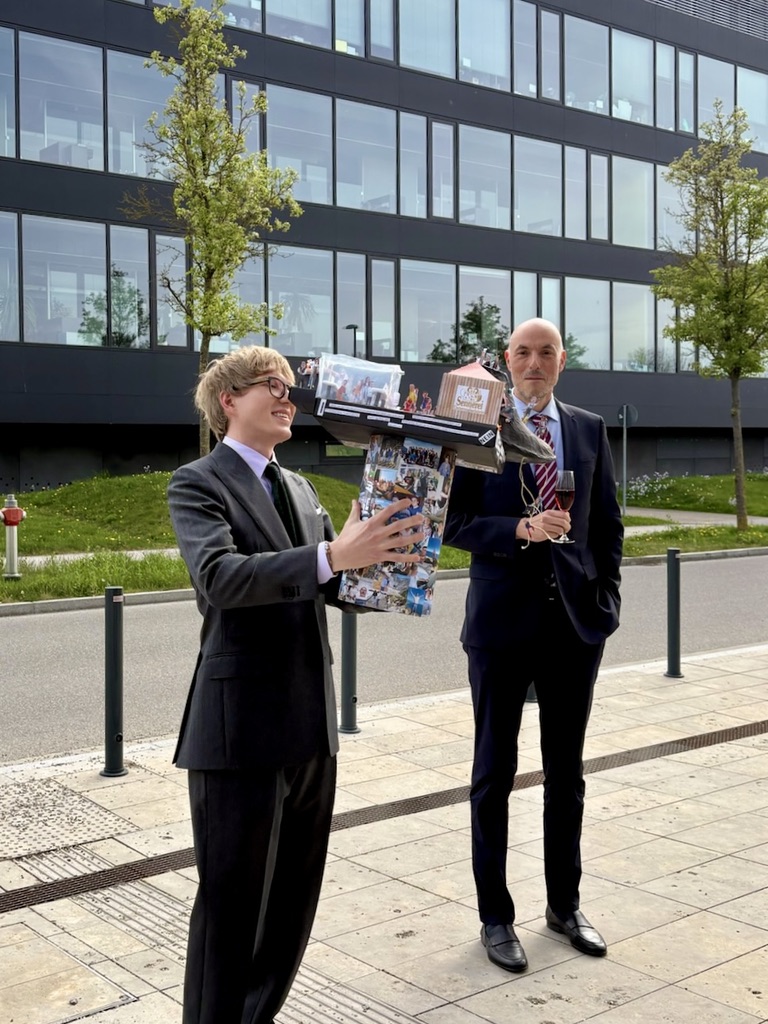
On 27 April 2026, I defended my doctoral thesis, Multimodal redundancy-reduced deep learning for drug discovery, and completed my doctorate with summa cum laude. It marked the end of an important chapter and gave me a good reason to look back at what made these years so valuable.
From biochemistry into AI
I am a biochemist by training. My transition into computational research began during my master's thesis, when I first started applying machine learning to biochemical questions. I enjoyed working at the interface of both fields and decided to continue in AI for drug discovery full-time. My doctorate at the Sieber Research Group was therefore entirely computational.
The central theme of my work was how to make useful predictions when experimental data are limited. In TwinBooster, we combined molecular structures with written assay descriptions to predict activity for assays the model had never seen. BarlowDTI used molecular and protein sequences to predict drug-target interactions without requiring experimental 3D structures. Together with experimental colleagues, I also helped connect generative modelling, prediction, automated synthesis, and biological testing in the discovery of a new antibiotic lead active against Gram-positive and Gram-negative bacteria.
Further projects made me more critical about how computational methods are evaluated. We carried out a prospective experimental assessment of structure-based drug design and found that plausible-looking generated molecules rarely translated into reproducible biochemical activity. In a later Chemical Science paper, we examined widely used biomolecular benchmarks and showed how leakage, conflicting labels, and redundancy can distort model comparisons.
A good place to learn
I am very grateful for the freedom and trust I was given at the Technical University of Munich. I was taught and mentored by great people who were generous with their time and knowledge. At the same time, I was able to develop my own ideas, manage projects, work closely with collaborators from chemistry and biology, and take responsibility for parts of our research infrastructure. That combination of guidance and independence was one of the most valuable parts of the experience.
Conferences were an important part of that experience. At Generative AI in Molecule Discovery at Helmholtz Munich, I presented a poster and met researchers working on related questions. At the Gordon Research Seminar and Conference on Computer Aided Drug Design in Portland, I joined discussions on next-generation methods and presented our work in a short talk and poster. Our prospective study of structure-based drug design was later presented by Joshua Hesse at the ICLR 2026 GEM Workshop in Rio de Janeiro. These meetings gave me a perspective on the field that papers alone cannot provide.
I am thankful to everyone who taught me, worked with me, and made the difficult parts easier. The freedom, shared projects, and people around them made these years both valuable and enjoyable. I am grateful for the experience and curious about what comes next 👀